
There has been a small explosion of cost-effective home automation gadgetry in the past few years. Among these are the MiLight series of remote-controlled RGB lights and accessories.
The MiLight series of lights make use of a proprietary 2.4Ghz protocol which allows the color of the lights to be changed, dimming of the lights or turning them off. There are a number of different devices in the series including the MR16 (12V DC/AC downlight shown below), but more conventional GU10s, E27s etc are also available.

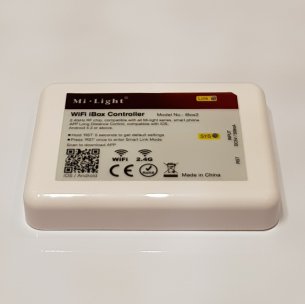
A WiFi hub can be purchased separately (shown below). This acts as a bridge between a WiFi network and the proprietary radio protocol allowing the lights to be controlled from a (somewhat clunky) app on Android and iOS devices.
So, on to the problem at hand… I recently purchased a chandelier (shown below) which is hard-wired to use non-dimmable, non-RGB LEDs. It is quite a pretty thing which matches my decor rather nicely, but it is a bit too bright and given the lack of color change capabilities, it does not incorporate very well in the lighting scenes in my living area.

The chandelier itself is quite similar to the design below, with a number of small surface mount LEDs on a PCB mounted into some sort of a steel ring at the bottom of the enclosure. But more on that later…

So, in theory it should be possible to disassemble 6 MiLight MR16s (or so I thought) and use the innards to replace the monochromatic LEDs inside the chandelier. The first point of investigation was into the MiLight MR16 RGB+CCT LED Downlight (shown below, along with a conventional halogen downlight for comparison purposes)

Disassembling this was relatively easy since the front lens is simply a snap-in. It was quite easy to pry the front lens off to expose the circuitry inside the device.
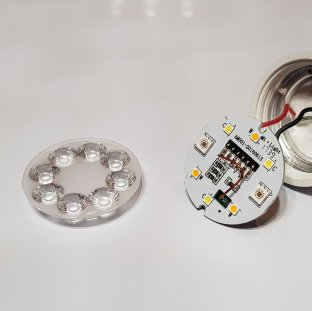
The housing holds a PCB to which surface mount LEDs are soldered. There are two small screws which hold the PCB to the inside of the housing. Once these are removed it reveals a power supply mounted at the base of the housing with some form of silicone. The PCB itself is just slightly less than 40mm in diameter which makes it almost exactly the right size to replace the plain white LEDs in the chandelier.
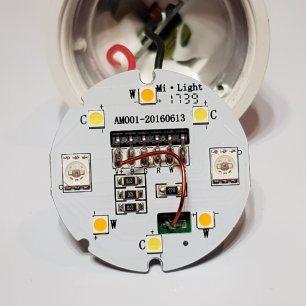
As expected the electronics inside are quite similar to what one would find by dismantling any of other MiLight LEDs such as this post (and is exactly the same board as found in the GU10 devices) but it has a second PC board which hosts the microcontroller attached to the bottom of the LED board (shown below). Jumpers from the microcontroller board are literally bent over and soldered to the top board, thus making it impossible to view the microcontroller board without damaging the light. Also notable is the additional pin to drive the CCT.
The power module at the bottom of the housing is essentially a voltage regulator and AC-DC converter. This is necessary since the MR16 is typically powered by a transformer or LED driver which are known to fluctuate quite spectacularly in the wild. Generally this is load dependant, with transformer based units simply not having enough current flow from an LED device to generate any useful output voltage. Depending on your existing driver it could also be either AC or DC (or a crude approximation thereof).
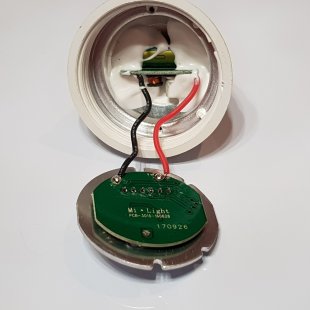
The power module of the two devices I disassembled provided 9.36V and 9.48V respectively which remains fairly constant as the lights are dimmed or the color changes (so not likely to be a constant current mode driver itself). From disassembling the GU10 later on, it appears that the actual desired voltage is 9.3V.
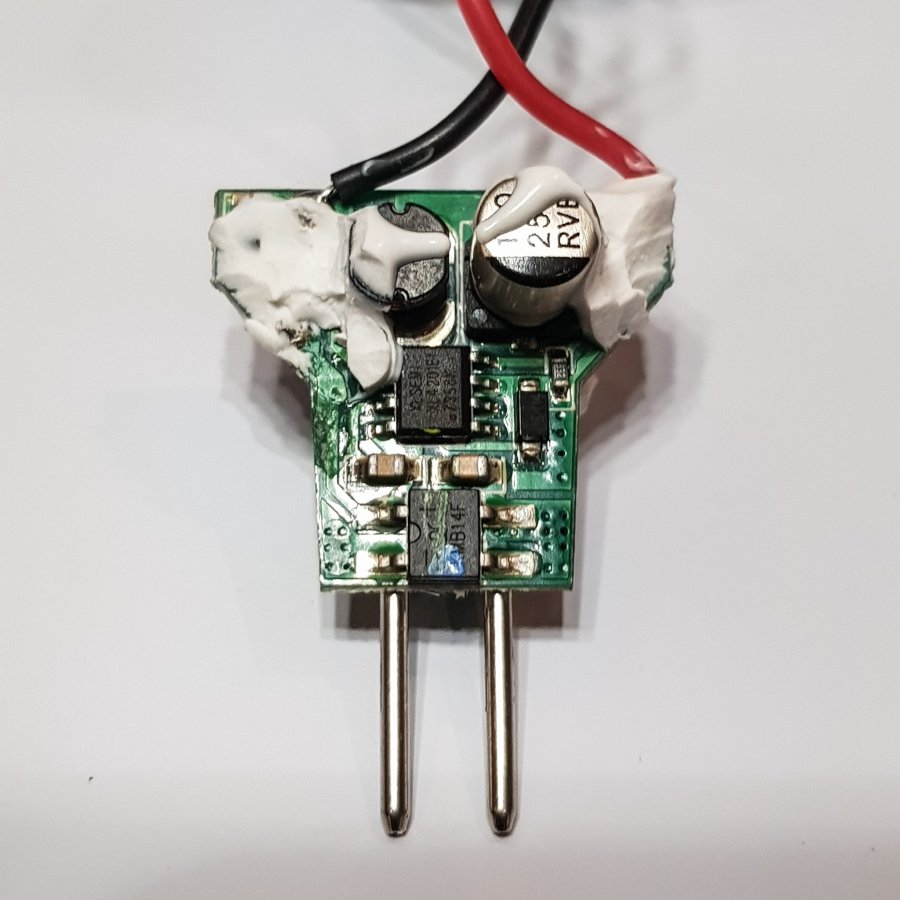
As with the majority of the MiLight devices, the light works and defaults to a cool(ish) white color temperature before it is slaved to the controller and its color is changed. On my previous transformer (designed for halogen downlights) the MiLight would not even have powered on.
With a smaller LED-compatible 12V AC driver, the device powered up but when dimmed (e.g. night light mode) the power supply caused a bit of flicker (one assumes this due to an under-loading condition). For this reason, this MR16 product is probably not a seamless replacement for existing Halogen and LED 12V downlights without potentially needing to replace the driver.

And there you have it… based on that it’s more useful to refit the chandelier with the MR16-equivalent bulbs running off a conventional 12V LED driver and use their built in power modules to step down the voltage to 9.3V.
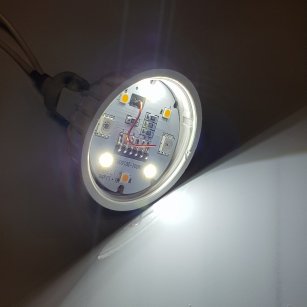
Below the obligatory picture of blinky lights which is common with this sort of post.

 Suren Pillay's Blog